


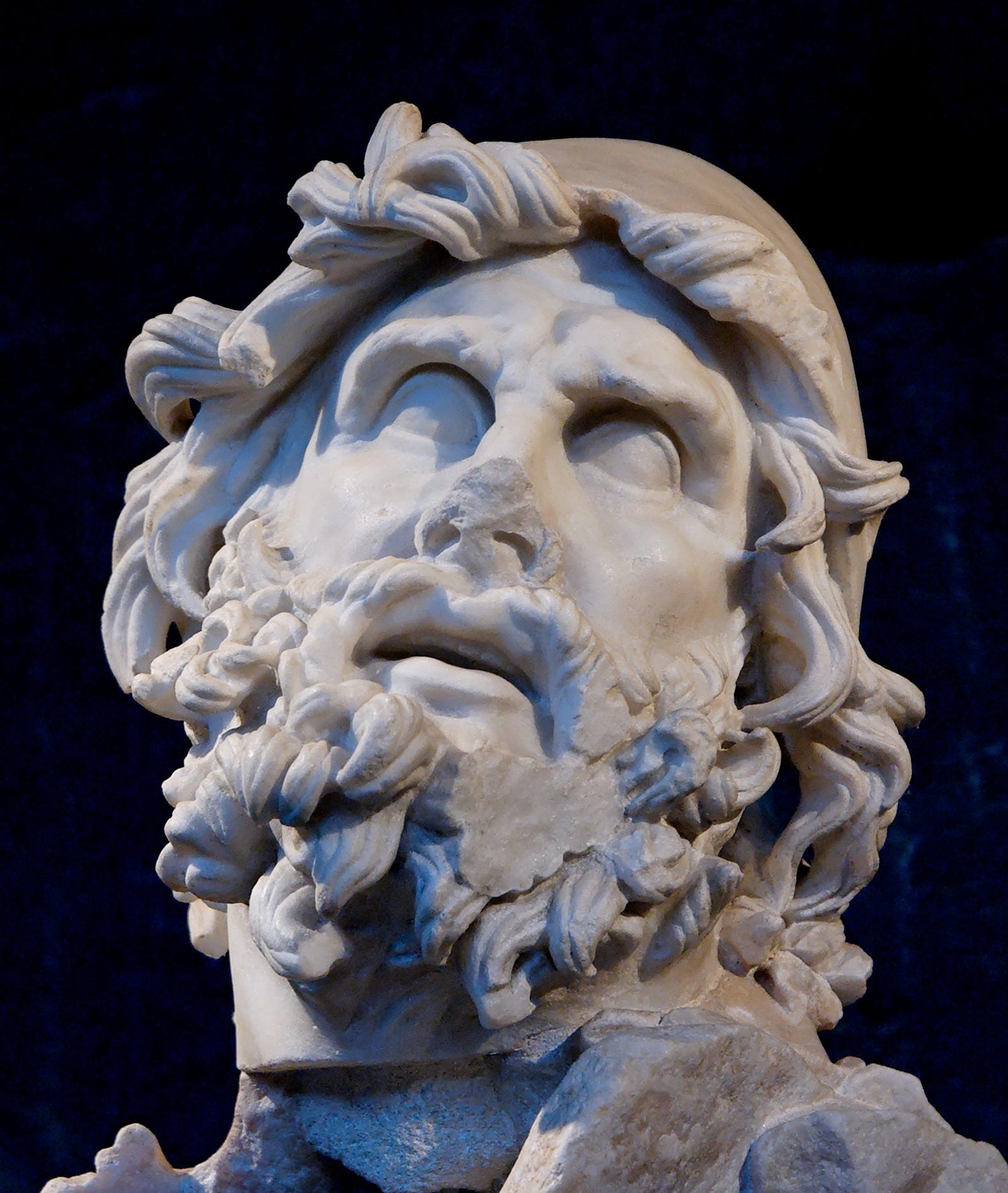
I’ve been thinking about all the different translations of The Odyssey.
I am far from a classicist. Before all the hype about the new IMAX version began, I still hadn’t yet read The Odyssey. This is probably for the best because I was able to appreciate the movie on its own terms. Even without having read it, much of it was familiar: Helen of Troy and the Trojan Horse, the lotus eaters, the witch Circe, the cyclops.
I knew when I eventually read it, I would want to read the Emily Wilson translation. First, because she is the first woman to translate it in full, and second, because of how her translation differs from the translations by men. (If you want to know more about that aspect, start here.) To better understand how Wilson’s is so radical, I now also need to read other versions.
But first, why not look at the first line from the Greek as translated by different people to see what sets them apart?
I started by finding the Greek text and then used what I had at my disposal to divine what it means on my own: Google Translate.
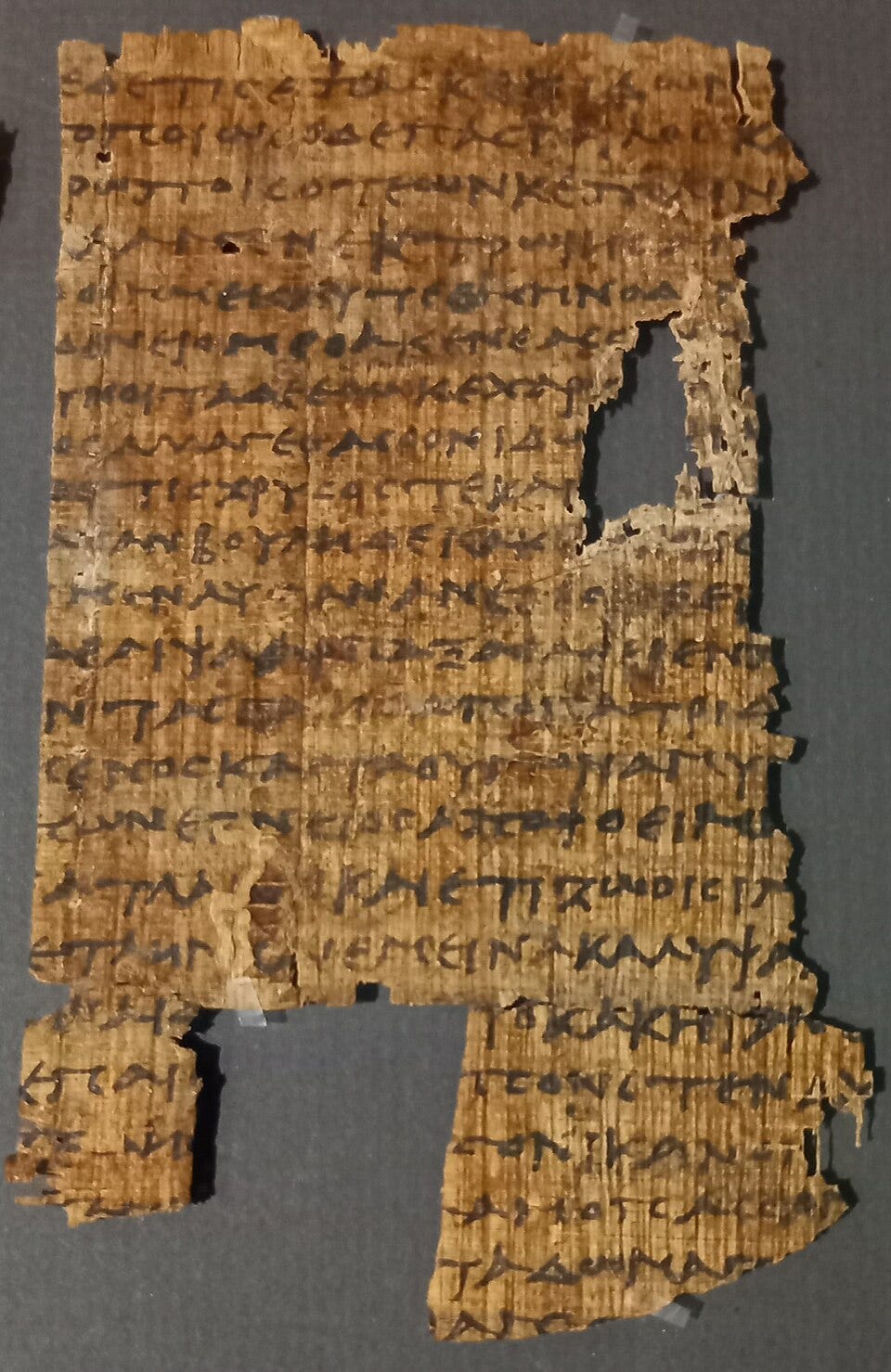
ἄνδρα μοι ἔννεπε, μοῦσα, πολύτροπον, ὃς μάλα πολλὰ
πλάγχθη, ἐπεὶ Τροίης ἱερὸν πτολίεθρον ἔπερσεν
Plugged in word by word, this is how it reads:
man to me tell of, muse, *multimodal, who greatly a lot
wandered, since of Troy sanctuary citadel he sacked
*This word also came up as “resourceful” but is definitely a word with layers of meaning. Wiktionary breaks it down: The word πολύτροπον is broken down into πολύ “polys” and τροπον “tropos”, meaning “many turns”. In fact, according to Dr. Jake Grefenstette, director of the International Poetry Forum in the 2025 video below, πολύτροπον / polytropos is one of the most contested words in translation history.
As a word nerd, I like how he discusses polytropos and Emily Wilson’s choice of the word “complicated” to represent it in her translation due to the etymology.
(In addition, I am impressed by the baby, and if you give it a minute, Emily Wilson will come on and talks about her work.)
How do the real translators interpret this? Again, I turn to the internet to discover—I am not the first person to investigate this. WordPress user REBFREY already did the work for me in collecting the first lines from different translations, to which I’ll add Thomas Hobbes, Robert Fitzgerald, Stanley Lombardo, and Emily Wilson. She (I am assuming REBREY is “she” based on the woman on horseback in the cover image on the blog) seemed to be actively translating The Odyssey in 2014. There are only a few posts, but then the blog drops off.
Here are the first lines, arranged in chronological order. (Forgive any lineation weirdnesses. Copy and paste is not your friend.)
1675, Thomas Hobbes:
Tell me, O Muse, th’ adventures of the man
That having sack’d the sacred town of Troy,
Wander’d so long at sea
1871, William Cullen Bryant:
Tell me Muse, of that sagacious man
Who, having overthrown the sacred town
of Ilium, wandered far and visited…
1897, Samuel Butler:
Tell me, O Muse, of that many-sided hero who traveled far and wide after he had sacked the famous town of Troy.
1951, Richmond Lattimore:
Tell me muse of the man of many ways, who was driven
far journeys, after he had sacked Troy’s sacred citadel.
1961, Robert Fitzgerald:
Sing in me, Muse, and through me tell the story of that man skilled in all ways of contending, the wanderer, harried for years on end, after he plundered the stronghold on the proud height of Troy.
1996, Robert Fagles:
Sing to me of the man, Muse, the man of twists and turns
driven time and again off course, once he had plundered
the hallowed heights of Troy.
2000, Stanley Lombardo:
SPEAK, MEMORY—Of the cunning hero, The wanderer, blown off course time and again After he plundered Troy’s sacred heights.
2017, Emily Wilson:
Tell me about a complicated man, muse, tell me how he wandered and was lost when he had wrecked the holy town of Troy
Here they are, in a list, all the ways Odysseus has been described in that first line:
“the man”
“that sagacious man”
“that many-sided hero”
“that man skilled in all ways of contending”
“the man of twists and turns”
“the cunning hero, the wanderer”
“a complicated man”
I am in no position to advocate for one version or another. This is all just to say—it’s more complicated than it seems. The next time you pick up a translation of a book you’d like to read, consider what the translator brings to the table and if one translation doesn’t resonate with you, put it down. Find another that does.
[The other option is to learn the source text’s original language, study the context of the time period in which it was written, and get busy with a translation of your own.]


I like the homework you gave yourself in exploring the various translations and the conversation this evokes. I won't see this new version because I LOVE "O Brother, Where Art Thou" by the Coen Brothers. It is so rich and layered and witty. When I see a good version of a text, I tend not to revisit it. I am enjoying hearing all of the talk about it, though. I used to teach The Odyssey, and I had fun with making it relevant and playing with the symbolism of the "obstacles" and "monsters." Knowing the translation it was based on does make me more curious, and knowing who played Helen of Troy makes me smile, but not enough yet to watch it.