


Dear readers,
At my last writing on June 8, I was struggling to finish Part Two of Volume III of War and Peace. I can now report that I have read up to that point and am about to crack open Part Three. I’m 112 pages away from Volume IV, the last volume before the Epilogue.
That’s all well and good, but the sad fact is that until this morning I hadn’t picked up War and Peace since June 8 except to move it around the room. sigh Yes, I’ve been reading other things, but still. Could I have at least snuck a few pages in here and there? I could have.
But you know what? I’m still here, still reading, and that’s what matters. And if by now I had decided I hated War and Peace and didn’t want to expend the time to finish it, it would be okay to put it down. We all have to make choices about what’s important to us. Some choices have real-world negative consequences. Choosing to read or not to read a book for pleasure is not one of them.
Moving along.
Everything comes at the right time to him who knows how to wait.
When I left off last time, the Commander in Chief of the Russian army, His Serenity Kutozov, said that “Tout vient à point à celui qui sait attendre”—Everything comes at the right time to him who knows how to wait.
It seems that that right time is now.
It is section XXIII and we find our dear friend Pierre hanging out in the vicinity of battle. Why? Because he wants to take part in the battle and is invited to ride along with Count Bennigsen. It just so happens that Bennigsen is heading to Borodino, which will prove a turning point for the war.
On the road in the midst of a birch woods “a brown hare with white legs jumped out onto the road in front of them and, frightened by the hoofbeats of the large number of horses, became so confused that it leaped along the road in front of them for a long time, arousing general attention and laughter.” This seemingly insignificant occurrence feels like a portent of what’s to come.
Meanwhile, Prince Andrei Bolkonsky “knew that tomorrow’s battle was to be the most dreadful of all he had taken part in, and the possibility of death presented itself to him” and his thoughts turn inward toward the “three main griefs of his life…. His love of a woman, the death of his father, and the French invasion that had seized half of Russia.” Later, Pierre and Andrei discuss how it is often said that war and chess are alike, but Andrei makes the points that in chess, “…you’re outside the conditions of time… a knight is always stronger than a pawn, and two pawns always stronger than one, while in war on battalion is sometimes stronger than a division and sometimes weaker than a company.” That while in chess there are set rules, whereas in war, success depends “on the feeling that’s in me, in him, in every soldier…. A battle is won by him who is firmly resolved to win it.”
Later, Prince Andrei says, “Take no prisoners. That alone would change the whole war and make it less cruel.” He evokes the hypocrisy of a woman being disgusted by the sight of a calf being slaughtered, but her eagerness to eat the slaughtered calf when it’s dressed up for a meal. If everyone had to kill their own meat, there would be fewer killings, he is arguing, and the same goes for war: that if the outcome of fighting a war was certain death, fewer people would go off to war for a simple disagreement.
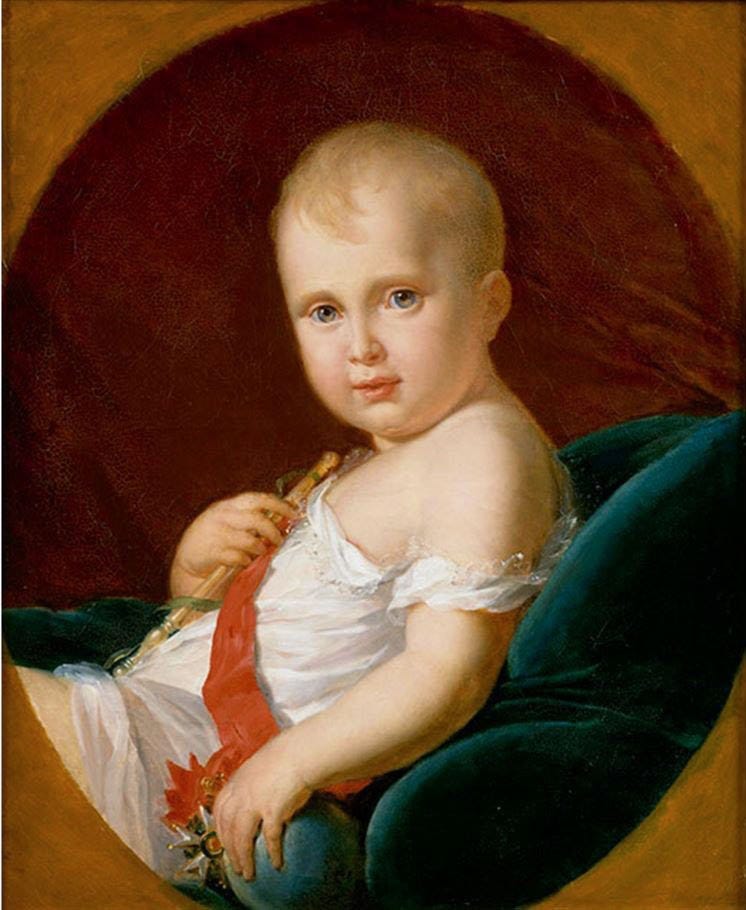
Soon, the scene shifts and we see the French side of the battle and Napoleon getting a vigorous body scrub from his servants. Someone brings a present from his wife—a portrait of his little son holding a globe in one hand like a rubber ball and scepter in the other, and the title of the painting is “The King of Rome”. He is certain of France’s impending victory and the expansion of the empire. Then he gives his orders for the day. A few paragraphs later, we are told what is about to happen: the battle of Borodino is lost by the French. Later historians will speculate this is “because Napoleon had a cold, that if he had not had a cold, his instructions before and during the battle would have been of still greater genius, and Russia would have perished, and the face of the world would have changed.” (Italics are in French in the text, English in the footnote.) It is the first battle that the French do not win and is a turning point in the war.
There are some really beautiful descriptions by Pierre in the ensuing passages:
The sun, having just burst from behind the cloud had covered it, sprayed its rays, half broken by the cloud, across the roofs of the street opposite, over the dew-covered dust of the road, over the walls of the house, the windows, the fences, and Pierre’s horses, which were standing by the cottage.
And:
…slanting rays of the bright sun, rising behind and to the left of Pierre, cast over it, in the clear morning air, a piercing light of a pink and golden hue, and long, dark shadows. The distant woods, ending the panorama, as if carved from some precious yellow-green stone, displayed the curved line of its treetops on the horizon.
And also:
…where the Voyna, between its swampy banks, flows into the Kolocha, hung that mist which melts, dissolves, and turns translucent in the bright sun, and magically colors and outlines everything that shows through it.
A few pages later, Pierre has made his way to a barrow which will prove to be critical to the war effort. And because Pierre, having decided he wanted to “help”, “[h]e was shouted at a couple of times for being in the way.” Pierre is our eyes and ears in the midst of battle, seeing it afresh, which allows the reader to see it through his eyes.
Meanwhile, Andrei is giving orders that the men not cluster together so they aren’t one big target and to instead spread out. A shell lands near him and an adjutant yells at him to get down, and like in the movies where everything is in slow motion, Andrei has time to contemplate what’s coming before the shell explodes. “Can this be death?… I can’t, I don’t want to die, I love life, I love this grass, the earth, the air…” And then, “From the right side of his stomach a large stain of blood was spreading onto the grass.” He is rescued and put on a stretcher “…and for a long time could not understand what was happening around him… Why was I so sorry to part with life? There was something in this life that I didn’t and still don’t understand.”
Finally, in the medical tent, he recognizes someone on the table opposite him. It’s Anatoly Kuragin, the rogue who spoiled his love affair with Natasha and forced him to call off his engagement. Anatole is being “shown his cut-off leg in a boot caked with blood!” and suddenly Andrei felt, “Compassion, love for our brothers, for those who love us, love for those who hate us, love for our enemies—yes, that love which God preached on earth, which Princess Marya [Andrei’s sister] taught me, and which I didn’t understand; that’s why I was sorry about life, that’s what was still left for me, if I was to live.” All he wished for now was, “rest, tranquility, and freedom.”
Now to keep reading to learn: Will Andrei find it? And has the tide really turned?
A few other things I’ve been thinking about related to the experience of reading:
Yes, I saw The Odyssey. Yes, I enjoyed it. No, I had never read it before. So I am rectifying that by listening to the Emily Wilson translation via Audible, because I was able to get it for 99¢. Yes, I will still buy the hard copy version, because I will need to read it again.
As I’ve been reading War and Peace today, I realize one of the pleasures of reading is hearing the book in my head. When I read, I don’t speed read (or at least I try not to) because I find I easily lose track of what I’ve just read. How is this different from “reading” via audiobook? In both cases, I am “hearing” each word as I read. The main difference as I see (pun?) is not being able to flip back and forth easily or see how the work is formatted on the page. I just finished Olga Tokarczuk’s Flights which is written in very short prose segments. I wanted to see how they were laid out on the page! I also love reading the intro and acknowledgements and even the copyright page. There is all sorts of information to be gleaned: who is thanked, what version of the book is this, what does the author look like and what do they emphasize in their bio? The obvious upside to an audiobook is that I can listen anywhere, whereas carrying War and Peace around with me would be a little awkward. But there are distinct pleasures to both experiences. There is also the fact that the reader of the audiobook makes all the difference. I just returned a book only about ten minutes in because I couldn’t stand the woman’s voice or her needless over-expression. Just read it, please. No need to add a whole lot of drama.
Tomorrow is August 1, which means the Sealey Challenge. Yes, I’m going to try and get through it this year. I have so many unread poetry books! But my focus will be on reading for pleasure. If I find that it’s not fun and it’s feeling more like a chore, I will read at whatever pace suits me and get through as many books as I feel like, even if it’s just one.
Happy reading, everyone!
Cati
Choices, indeed! I’m glad you are back at it. It sounds like Tolstoy’s metaphysics are emerging.
I’m soooo behind. Will I ever pick it up again? Maybe your excerpts are the only way I’ve “read” it. 😬😂